
September 16, 2024 16:33
 HolyGrail 2.0 represents a further development in managing end-of-life flexible packaging. The initiative uses "digital watermarking" of plastic packaging to identify and recycle materials by fraction or application.
In industrial trials, the separation of hygienic LLDPE films and food-use polypropylene films from mixed waste streams has been validated by combining digital watermarks and Near-Infrared (NIR) identification technology.
Advanced sortation using digital watermark technology from provider Digimarc and an add-on module from machine vendor Pellenc ST has been successfully validated in an industrial setting at Hündgen Entsorgung’s material recovery facility (MRF) for separating flexible packaging.
The trial took place between December 2023 and February 2024 under the supervision of the HolyGrail 2.0 technical team. Tests were performed on real streams that were bulked up with additional quantities of digitally watermarked PP films, as well as LDPE films produced by brand owners Essity, Kraft Heinz, PepsiCo, and Procter & Gamble.
The focus was on sorting flexible packaging to create specific streams of food-grade PP fractions and hygiene-grade PE flexible fractions. The results are summarized in the following table:
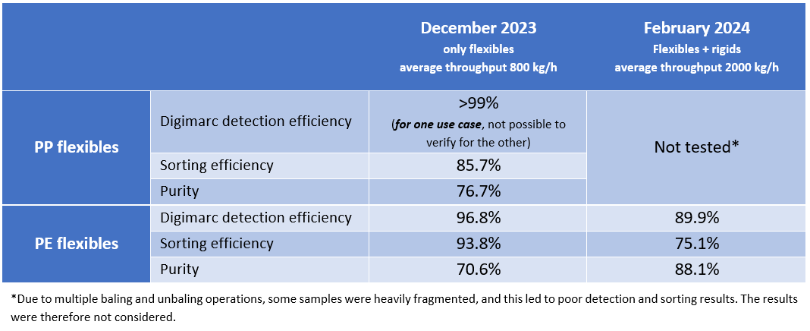
The trials conducted late last year, using single-stage sorting, demonstrated on average more than 95% detection efficiency, more than 85% sorting efficiency, and more than 70% purity. These results were from single-pass sorting. It is expected that two-pass sorting, typically used in recycling plants, will further improve the purity of the output fractions by around 20%.
More complex, contaminated streams were tested in February 2024. The single-pass sorting of PE films achieved 89.9% detection efficiency and 75.1% sorting efficiency, while purity was 88.1%. Performance was negatively affected by higher, more variable throughput, the presence of mixed flexible and rigid materials, dirtier waste, and a higher volume of baled waste.
"Achieving the EU's mandatory 2030 goals for incorporating recycled plastics into packaging will require substantial changes across the entire value chain, notably for manufacturers and retailers that utilize plastic packaging," the initiative's promoters emphasized. "New technological advancements are poised to fulfill these requirements, presenting opportunities for pioneers in the packaging sector's circular economy."
At the same site, a three-month test campaign is set to begin in the coming weeks to evaluate the sorting of post-consumer waste from rigid packaging, equipped with digital watermarks, introduced to the Danish and German markets by various companies participating in the project. Two detection equipment prototypes, jointly developed by Pellenc ST and Digimarc, will be installed on the sorting line for this purpose.
Two large-scale recycling tests with the sorted material will complete Phase 3 of the project. Borealis is currently conducting tests on PP films and LDPE flexible fractions sorted by Hündgen Entsorgung. Recycling tests will subsequently be conducted at another site on non-food-grade PET bottles collected from the rigid packaging sorting campaign.
© Polimerica - Reproduction prohibited, all rights reserved
