
October 14, 2025 17:36
 Bad news for Europe’s plastics industry from K2025 in Düsseldorf — though few will be surprised.
PlasticsEurope unveiled its latest Plastics the Fast Facts 2025 report, providing a detailed picture of the sector’s performance in 2024 and confirming the extent of the downturn.
Last year, European plastics production remained virtually flat at 54.6 million tonnes (+0.4%), following a sharp 7.6% contraction in 2023. This stagnation has pushed Europe’s global production share down to a historic low of 12%, compared with 22% in 2006.
Industry turnover has also slumped, falling from €457 billion in 2022 to €398 billion in 2024 (-13%). Over the same period, the number of companies dropped by around 3,000, and employment declined by 35,000 jobs, leaving the industry with roughly 1.5 million workers.
 The only slight improvement is the trade balance: still negative across the EU27, but narrowing from -0.8 million tonnes to -0.2 million tonnes, thanks to a 10% rise in exports. The United States remains Europe’s main source of polymer imports (18.9% market share) and its fourth-largest export market (7.7%).
Europe’s decline, however, stands in stark contrast to global trends. Worldwide plastics production grew by 4.1% in 2024 and by 16.3% since 2018.
Asia now dominates the market with 57.2% of global output, while China alone accounts for 34.5% — nearly three times the entire EU’s production.
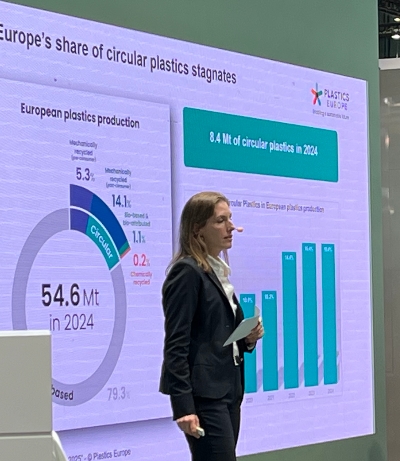
The picture is equally bleak for circular plastics — both bio-based and recycled. In 2024, total circular plastics output in Europe held steady at 8.4 million tonnes. Mechanical recycling grew by just 2.7% to 7.7 million tonnes, while chemical recycling stagnated at 110,000 tonnes.
Bio-based plastics fell sharply by 25% to 600,000 tonnes.
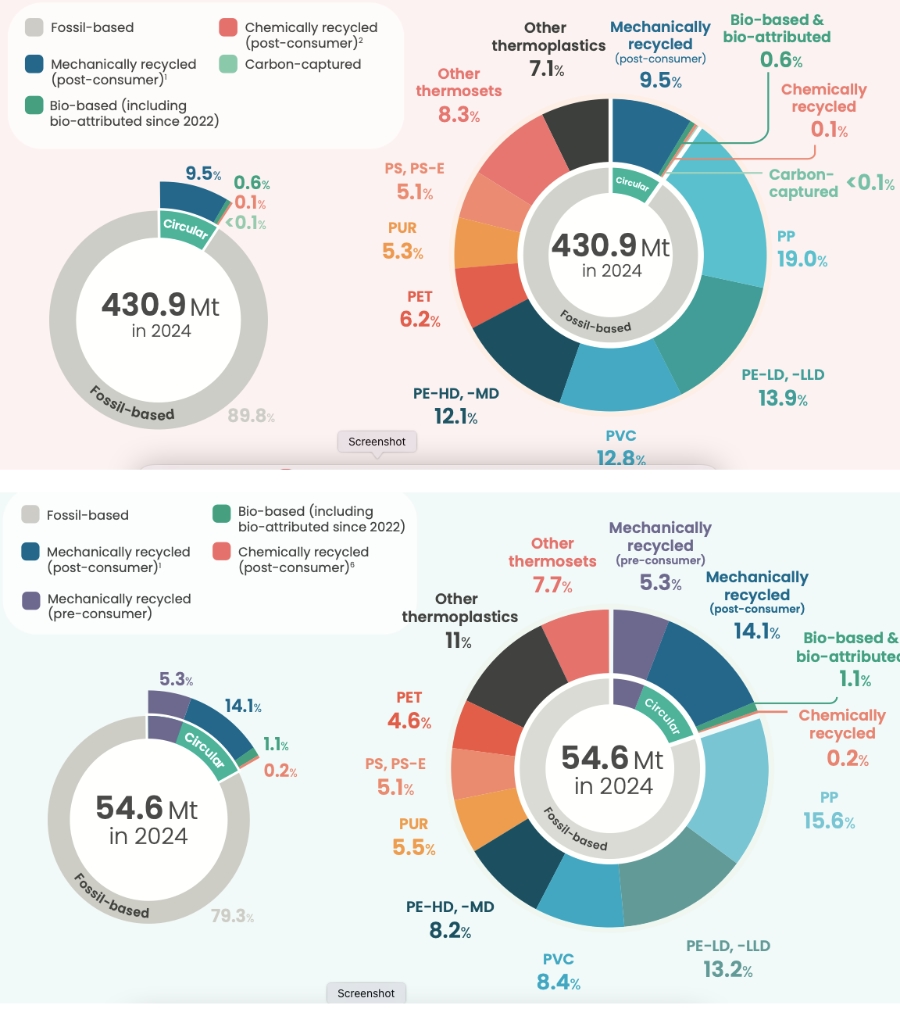 By comparison, global circular plastics production reached 43.9 million tonnes last year, surpassing 10% of total global output for the first time — driven largely by China, which produced 13.4 million tonnes, nearly double Europe’s total.
Speaking at K 2025, Virginia Janssens, managing director of PlasticsEurope, warned: “Europe’s plastics industry is at a cliff edge as competitiveness collapses. The alarm bells should be ringing in Brussels and across EU capitals. Europe must decide whether it wants to lead the world’s first circular plastics system or decarbonize through further deindustrialization.”
To address the situation, PlasticsEurope issued a call for urgent policy action at both EU and national levels. The association identified four immediate priorities:
© Polimerica - Reproduction prohibited, all rights reserved
