
June 19, 2026 16:13
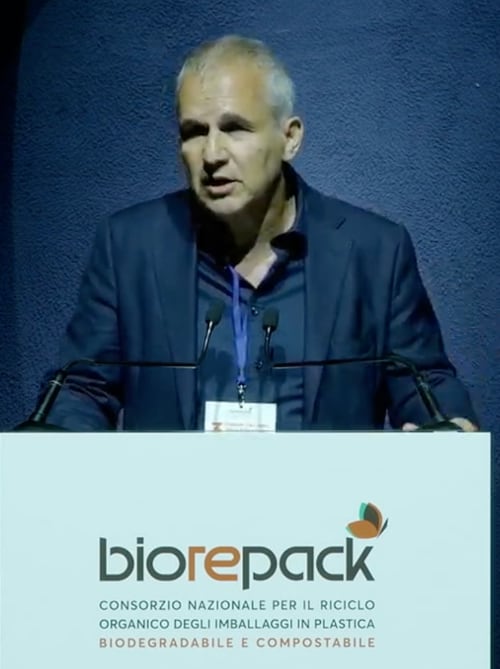
 After another negative year in 2025, also marked by falling volumes, the Italian compostable plastics industry has begun to reflect on the future of the sector. The aim is to identify new strategies to overcome a crisis that appears increasingly structural, although Biorepack president Armido Marana (pictured) prefers to describe it as “accidental”.
The issue was at the centre of the third Compostable Bioplastics Forum, organised yesterday in Rome by Biorepack in collaboration with Assobioplastiche, the Italian industry association.
Two analyses were presented during the meeting. The first was the annual market observatory prepared by Plastic Consult, a Milan-based consultancy. The second, more focused on industrial strategy, was presented by Francesco Bertolini, professor at SDA Bocconi School of Management, based on a survey conducted among Italian producers and converters.
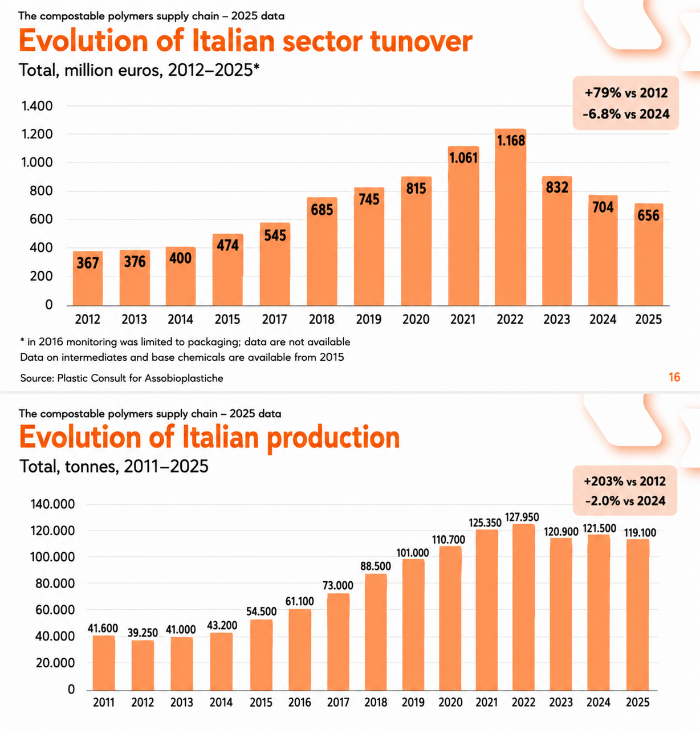 In 2025, the main indicators for the Italian compostable plastics sector deteriorated. Turnover fell by 6.8% to €656 million, marking the third consecutive year of contraction. Production volumes declined by 2% to 119,100 tonnes. The number of companies also fell, by 9.4%, as did employment, down 2.6%.
The SDA Bocconi survey sought to assess the health of the sector from within, through an anonymous questionnaire sent to companies. A total of 56% of the companies surveyed believe the sector is doing well, while 44% consider the situation negative or very negative.
The main concerns relate to Asian competition, weak demand in traditional applications and regulatory uncertainty.
According to the research, international competition is an important factor, but the main issue concerns the strategic positioning of the Italian supply chain.
“If compostable bioplastics continue to be perceived as simple commodities, it will be very difficult to compete with economies that operate at scale and with lower costs, such as China, which is also supported by state incentives,” Bertolini explained. “The most promising perspective is instead to enhance their value as components of ecosystem services and to integrate them increasingly with high value-added sectors such as food, cosmetics and pharmaceuticals, where sustainability, innovation and quality are distinctive elements.”
 Innovation, Bertolini (pictured) explained, will be decisive. However, the survey shows that only 7% of Italian operators in the sector currently consider product innovation an absolute priority. By contrast, 52% believe it is more important to introduce rules capable of supporting the end market, while 3% focus on research and dialogue with other players in the supply chain.
There would therefore appear to be room for improvement, especially through technological differentiation, new functionalities and integration with other production sectors. For Bertolini, innovation is also the most effective way to enhance a central feature of compostable bioplastics: their ability to fit into Italy’s system for managing the organic fraction of waste.
The survey also asked entrepreneurs how they see the sector in ten years’ time. A total of 13% expect turnover to grow, 41% expect values to remain in line with current levels, while 6% fear a 50% reduction in sales. A similar share even envisages the disappearance of the sector and its incorporation into the conventional plastics industry.
 “The 2025 figures do not surprise us: they are the consequence of economic dumping, stagnant consumption and regulatory uncertainty,” commented Assobioplastiche president Luca Bianconi on the sidelines of the conference. “However, precisely in this scenario, a proactive vitality is emerging, and that is the real insurance policy for our future.”
“The challenge posed by European regulations, the PPWR, and national rules is not seen merely as a compliance requirement, but as the kick-off for a restart on new foundations,” Bianconi added. “It remains essential to overcome political deadlocks, such as the one affecting the capsules segment, in order to unlock investments that are only waiting for a clear direction.”
© Polimerica - Reproduction prohibited, all rights reserved
