
September 17, 2026 16:58
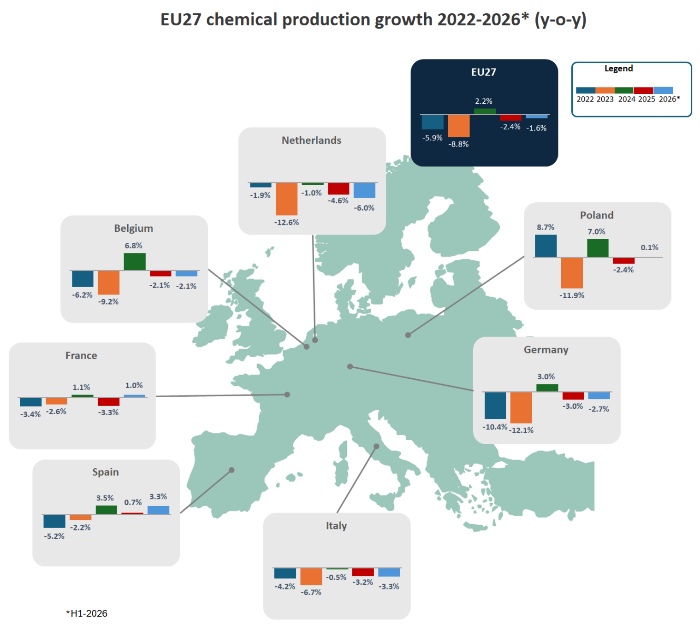 In the first six months of the year, the European chemical industry showed some signs of stabilisation but remained far from a solid recovery.
In its Chemical Trends Report Q2 2026, Cefic - the European Chemical Industry Council - reported a 1.6% decline in EU27 chemical production compared with the same period in 2025.
The modest improvement in market conditions was mainly driven by prices. Producer prices increased by 4.2%, while sales, based on data available from January to May, rose by just 0.4%.
According to Cefic, this divergence confirms the persistent weakness of production volumes and underlying demand.
Production increased in Spain (+3.3%) and France (+1.0%), while declining in the Netherlands (-6.0%), Italy (-3.3%), Germany (-2.7%) and Belgium (-2.1%).
Polymers were among the weakest-performing segments, with production down 6.5%, second only to other organic basic chemicals, which fell by 9.2%. The sector continues to be affected by global structural overcapacity, weak demand and competitiveness challenges.
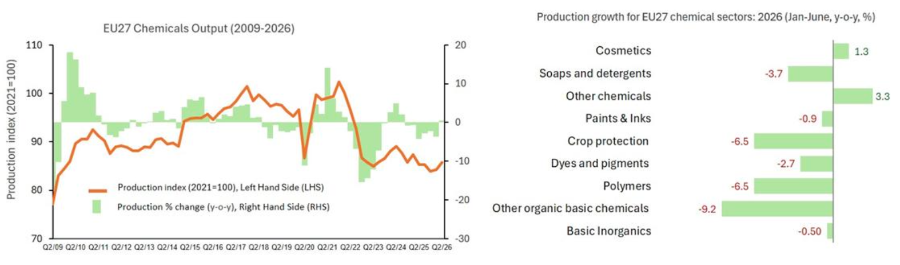
The rubber and plastics manufacturing sector performed better overall, with output increasing by 1.4% year on year in the second quarter, although no breakdown between the two segments was provided.
Capacity utilisation also remains a concern. In the third quarter, the rate increased to 75%, but remained well below the long-term average of 81.3%.
Energy costs remain another major concern. Between January and July, Europe’s benchmark TTF gas price averaged €45.1/MWh, compared with €12.5/MWh for the US Henry Hub benchmark on a comparable basis.
Extra-EU trade also weakened. In the first half of the year, chemical exports declined by 6.3% to €107.1 billion, while imports fell by 5.9% to €88.7 billion. The trade surplus remained positive at €18.4 billion but narrowed compared with the previous year.
© Polimerica - Reproduction prohibited, all rights reserved
