
February 27, 2026 15:04
 The European Commission has adopted the first delegated act under the new Regulation on Packaging and Packaging Waste (PPWR), easing one of the most debated provisions of the framework: the 100% reuse requirement for certain transport packaging components.
Adopted on 25 February, the measure exempts wrapping film and straps used to secure goods on pallets when they are used within the same company or between economic operators located in the same Member State.
This marks the first practical application of the delegated powers granted under the PPWR. Article 29 had originally set a stringent target requiring full reuse of these components in internal and domestic logistics flows. The provision had prompted widespread concern across the sector, culminating last October in the announcement to the European Plastic Films (EuPF) association that a derogation was under consideration. That exemption has now been formalised.
The Commission based its decision on a study indicating that systematic reuse of films and straps would generate disproportionate adaptation costs relative to the expected environmental benefits. The exemption is therefore presented as a way to balance sustainability objectives with technical and economic feasibility for operators.
 The broader framework of the regulation remains unchanged. From 1 January 2030, a minimum 40% reuse target will apply to transport and sales packaging placed on the EU market. The requirement covers a wide range of formats, including pallets, collapsible crates, boxes, trays, intermediate bulk containers (IBCs), buckets, drums and jerrycans, as well as wrapping films and straps. The Commission stresses that exempting these specific components allows economic operators to contribute to the overall target without incurring excessive burdens in particular applications.
While the sector has welcomed the clarification, concerns remain. The exemption does not apply to transport between different economic operators or between two EU Member States. In such cases, the reuse obligation under Article 29 continues to apply, leaving a significant share of European logistics flows subject to the original requirement.
EuPF has focused its response on this point, describing the failure to extend the derogation as “a missed opportunity.” According to the association, the same evidence that led the Commission to exempt domestic and intra-group transport should also apply to intra-EU cross-border movements. Ignoring these factors, warns director Thomas De Meester, could result in higher emissions, billions of euros in additional costs and reduced competitiveness for European industry.
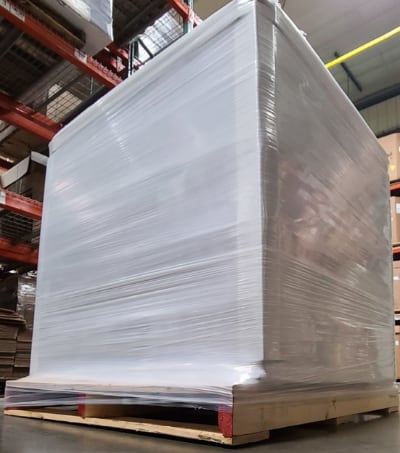 EuPF argues that stretch films and straps are essential to modern, automated, high-speed logistics and are used across almost all industrial sectors. During the public consultation, the association notes, European industry broadly supported extending the exemption to cross-border transport, citing concerns not only about environmental sustainability but also about operational feasibility, safety and load stability.
The association also highlights the economic impact of the measure. The reuse requirement for films and straps in palletised logistics could generate annual costs of around €4.9 billion, alongside additional investments of between €4.7 billion and €5.3 billion. Export-oriented companies would face particular challenges, as reusable packaging would be difficult to recover from third countries. This could force companies to operate parallel systems for intra-EU and extra-EU flows, further increasing operational complexity.
In light of these concerns, EuPF is calling on the European Commission to reassess the available scientific evidence and consider a further delegated act amending Article 29(1) to extend the exemption to intra-EU cross-border transport.
© Polimerica - Reproduction prohibited, all rights reserved
