
March 27, 2026 16:13
 On March 18, Italian granulator manufacturer CMG opened its plant to customers and partners to present its latest technological and commercial innovations in plastic waste shredding and granulation.
The previous day, as part of the same event, the company had organised a seminar at the Museum of Industrial Heritage in Bologna focused on plastics recycling.
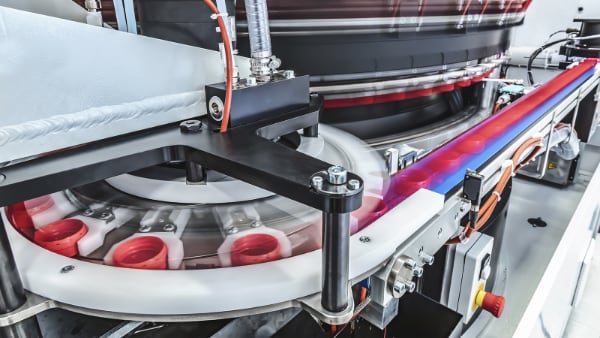
Among the speakers at the conference, Iacopo Bianconcini of the Sacmi group outlined the PureCap project, which the Imola-based group presented last year at K2025: the continuous compression moulding of HDPE bottle closures containing post-consumer recycled material qualified for food contact, using its CCM machines (Continuous Compression Moulding).
It is one of many solutions companies in the sector are seeking to bring to market ahead of the entry into force of the EU Packaging and Packaging Waste Regulation (PPWR), which, among its various requirements, also calls for greater use of recycled content.
 “By 2030, single-use plastic beverage bottles will have to contain at least 30% recycled content from post-consumer waste,” Bianconcini explained. “And although it is still unclear whether the HDPE cap will fall into this category or that of ‘contact-sensitive packaging’ with a 10% target, the direction is unmistakable.”
Even without regulatory pressure, taxes on virgin plastic in packaging — already introduced in the UK and Spain — and incentives in France for the use of recycled content are pushing in the same direction.
With PureCap, Sacmi offers a turnkey system that goes beyond the machine itself — CCM, already widely used to produce closures from virgin HDPE — and includes everything needed to achieve the final result: closure design, mold, the production recipe with the optimal mix of virgin and recycled plastic, the pigment needed to obtain the desired shade, and the settings for the entire line. The new element is that Sacmi will also be able to supply recycled resin optimised for moulding and formulated in its own laboratory to each customer’s specifications.
 Sacmi is therefore positioning itself not only as a material supplier, but also as a company that has brought recycling expertise in-house, including the relevant RON code. To this end, it has opened a dedicated department at its manufacturing hub in Imola, near Bologna, where it uses technology from Austria’s Starlinger for the decontamination, filtration, extrusion and deodorisation of regenerated material, in a process already approved by EFSA for food-contact applications. The plant is fed with HDPE derived from polyolefin waste streams — mainly the PE fraction from PET bottle streams, which is already food grade — sorted by colour family.
The rHDPE pellets are not pre-blended with virgin resin at Sacmi, allowing greater operational flexibility: the formulation can be adjusted according to the type of closure, for example for still or sparkling water, or other variable parameters. For this reason, blending takes place directly in the plasticising section of the press.
As regards food-contact compliance, the material has been deemed safe under EU Regulation 10/2011 for containers with a capacity of no less than 54 ml — because the calculation is based on the ratio between the contact surface area of the cap and the bottle volume — a condition that covers most beverage bottles currently on the market.
 Tests carried out in the Imola-based group’s laboratories have shown that, in terms of resistance to stress cracking, a closure made entirely from rHDPE is suitable for bottles containing still water — although some virgin content is always recommended — while for carbonated beverages the recycled share can reach up to 35%.
According to Bianconcini, switching to rHDPE or to a blend with virgin material does not require any modifications to the molds, ensuring a smooth transition.
As for commercial development, Sacmi will start delivering the first batches of material in April, with the aim of seeing bottles fitted with closures containing 30% rHDPE on retail shelves over the course of the year.
Sacmi does not intend to limit the project to Italy. With a market share of less than 10% in its domestic market, but a strong presence in Africa and Asia, the company sees this project as a globally scalable model.
© Polimerica - Reproduction prohibited, all rights reserved
